Proud Mary

thOLNQEL5G  Right-Click to Download    This iconic tune was written by John Fogerty and recorded with his band Creedence Clearwater Revival  in 1969.  The bands’ name came from three sources:  Fogerty’s friend Credence Newball (the spelling changed to creedence for “creed”), a commercial for Olympia Beer (clear water), and the band’s almost religious dedication to their music (revival).  Cool, huh?  I first heard them in my dorm room in college and I’ve been a fan ever since.  Fogerty loved Beethoven’s Fifth Symphony… you know the intro “dit, dit dit…dah”.  Those notes inspired the first two chords of  “Proud Mary”, C and A.  Who knew we were listening to classical all along.

“Proud Mary”, however, is probably the most over-played song in America (other than “Brown-Eyed Girl”, which I’ve grown to despise).  I mean, EVERYBODY played this song, and I’m as guilty as the next guy.  First we all played it like Creedence for, like, ten years.  Then we had to do it like Ike and Tina Turner… well, I never did that – hated it!  So if you’re tired of performing it the same old two ways (there’s always a request for it), here’s my version for you to try.  Be brave – trot this one out there for fun and see what happens (the midi backing tracks are on the Pop/Rock list).  And if some idiot says, “Hey, that ain’t the Proud Mary I know” – pat him on the back, buy ’em a drink, and suggest that he get a life.

Stuck in the 70’s

thDSJEW3TN  Right-Click to Save    Actually, I’m stuck in the 60’s, but 70’s makes me sound younger.  But from 1975 to 1979 I was in a “wedding band” (of sorts) and I’m pretty certain we did this song.  There are people who can set me straight on this, but if we didn’t do it… we should have.  We had a fabulous “chick singer” who would have more than nailed “You’re So Vain” by Carly Simon.  But I digress…

Fans of Carly have always wondered who the song was about.  Personally, I suspected it was Warren Beatty, but no one knew for sure… except Carly, of course.  I started this little article 2 days ago with the intent of revealing Beatty as the culprit.  Doncha’ know this morning I read in the paper that Carly is now telling all… and it’s (yep) Warren Beatty.  What a coincidence, huh?  Thanks a lot, Carly.  Steal my thunder, why don’t you.

Anyway, this would be a great song in your repertoire if it’s not already there.  An interesting aside…. Carly confirmed Warren was the second verse, but is not telling who the rest of the song is about (clever lady – keep the mystery flowing).  Despite her explanation that only a part of the song is Beatty, she said, “Warren thinks the whole thing is about him”.   What a guy….

Check out the lyrics on the link below:

http://www.lyricsfreak.com/c/carly+simon/you+are+so+vain_20354877.html

You Belong to Me

Pyramids-at-Sunset-Cairo-Egypt2  Right-Click to Save    At any given moment, you’ve got a song in your head. Oh, you may not be conscious of it – but it’s there – churning away the rhythm of whatever you’re doing. You may have heard it on the radio 30 minutes ago, or maybe it’s an old favorite, or perhaps you heard a repairman whistling a certain tune and you stole it from him. You can’t help yourself… you’ll suddenly be humming that melody and you can’t get it out of your head – until the next tune comes along.  The song I most often hear (when I’m paying attention) is “You Belong to Me”.  I’ll burst out with “see the pyramids along the Nile” for no reason at all…. but I’m a little strange anyway.

You Belong to Me was first recorded in 1952 by Sue Thompson (who’s that?) on a country label (groan).  Then Patti Page gave it a shot (not good).  Then, at last, Jo Stafford did a cover version and it became the hit it was meant to be.  And The Duprees had a bebop hit with it in 1962.  This is our arrangement and Karen does a mighty fine vocal of this old standard.  I used an ocarina for the melody line, but a “chick singer” works much better.  Download the midi off the Pop/Rock list.  Musicians, this should be in your set list – that’s an order.

What Goes On?

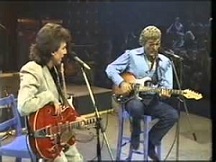
thED2K3AX1  Download with Lead   This tune was released by The Beatles in 1965 and was considered their first venture into country music.  It was written by Lennon and McCartney, but Ringo had a hand in it too.  He always says he only wrote five of the words and hasn’t done a thing since (probably true).  George Harrison idolized Carl Perkins, and you can easily recognize Carl’s style in George’s lead guitar on this song (that’s Carl and George together in the picture above).

It was recorded in one take with overdubs in the studio.  If you go back to the original recording, you can hear Lennon say something and they just left it in.  After the lead break when Ringo sings “Tell me why”, John muttered “We already told you why” – which was a reference to the song “Tell Me Why” recorded a year earlier.  Just a fun fact, folks…. bear with me here.

What I like about my arrangement (and I do like my arrangements)…{smart ass}… is the ability of my keyboard to imitate backup vocals.  If you listen carefully, you can hear the “ooohs” behind the lead organ.  If you have backup singers, just mute tracks 3 and 4 – but if you’re singing by yourself, mute the organ (track 2) and leave the backups (like you wouldn’t know that).  Try it at your next gig (it’s on the Country list).  It’s different and fun.  If they boo you off the stage, don’t blame me – you didn’t do it right.


Please, Mister Postman

thWLL0ID09  Download with Lead    I always thought this was a Beatles song and it was one of my favorites.  Paul and George had wonderful, clever backup vocals, and John Lennon on lead was just – well… John (the best rock’n’roll voice of all time).  But, in truth, they only covered the song – as was the case with a lot of the tracks on their first two albums.

This song was actually the debut single by The Marvelettes (warning… girl group) in 1961. “Mister Postman” was the first Motown recording to reach number one on the Billboard Hot 100 list.  It soared to number one on the R&B charts as well.  Then the Beatles covered it in ’63 (by far the best version) but, in 1975, The Carpenters again took it to the top of the Hot 100.  Obviously, this tune has a lot of mileage on it, but we’ve decided to work it into our repertoire as an “oldie”.  My arrangement is kind of a combination of  The Beatles and The Marvelettes  (Beatlettes?).  If you’re interested in performing it, best if you have at least three singers or a harmony box.  The sequence is on the Pop/Rock list without the lead.  Feel free to download and use my version if you like… my lawyer won’t call your lawyer, I promise.

Teddy Bear

th1C0KGTLA  Download with Lead    Everybody can sing like Elvis… at least they think they can. Why else would there be so many impersonaters? And don’t tell me you haven’t chortled “Love Me Tender” at least once in the shower.  But I’m here to tell ya nobody sings like “the King”.

“(Let Me Be Your) Teddy Bear” reached No. 1 on the charts for 7 weeks in 1957.  Elvis recorded it for the soundtrack of his 2nd movie Loving You.  This was the first time he was actually the star of a movie.  In 1956, he had a supporting role in Love Me Tender, which apparently  impressed the right Hollywood people who thought Elvis should be a film star.  Personally, I’d rather have him sing than act – but that’s just me.

Download the song off the Pop/Rock list without the lead and sing along in the shower.  You’ll sound just like Elvis, I’m sure.

Baby Love

thHI8HM03K  Download    Ever wonder why all Motown records sound remarkably alike?  Several reasons, actually.  The drum track uses a snare on every beat instead of just on 2 and 4.  So, you end up with a snare hit 4 times a measure instead of the customary 2 times (I find this mildly irritating and overdone – much like a ribeye that’s been on the grill too long).  And quite often they would use two drummers on the same track (talk about overdone).  Two guys, Berry Gordy and Smokey Robinson, oversaw the production of every recording – so you’ve got the same musical tastes over and over again.  Add to this the always present “call and response” singing style that female groups were so adept at doing (men don’t pull that off very well).  Oh, and into the mix goes the fact that the same band, “The Funk Brothers”, was the backup band on every recording.  No wonder Motown is so easily recognizable…

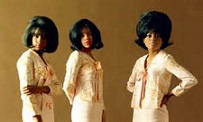
“Motown” is a portmanteau of motor and town and some great music came out of Detroit from 1959 to 1971.  “Baby Love” is certainly one of them.  It was recorded by The Supremes in 1964 and is ranked #324 on the Rolling Stone list of “500 Greatest Songs of All Time”.  Instead of using a snare four times in a measure, it uses a “clap” track, but you can ignore that after a while.  It’s a terrific song nonetheless and should be in your repertoire..  We’re working up a Motown set for an upcoming party and this one will certainly be in it.  Check the Pop/Rock list to download the backup midi track.

Watch The Supremes do it on the link below:

Cecilia

th  Download MP3    Who knew there was a Saint Cecilia?  And who knew she was the patron saint of music?  “Cecilia” is the third cut on the iconic Bridge Over Troubled Waters album by Simon and Garfunkel. It was their fifth and final album together.  Garfunkel pursued a short-lived acting career while Paul Simon went on to write and produce some of the most interesting music ever… and this song is a good example of Simon’s “quirkiness”.

Paul wrote this song with Saint Cecilia in mind… at least that’s what he claims.  How the somewhat raunchy lyrics match up with the activities of a saint we’ll never know.  But it’s still a fun song to do on a job.  The beat is unusual – almost a fast reggae but not quite.  It results from a late-night party when the duo and a couple friends started beating on a piano bench.  They recorded the beat with an old Sony tape recorder with reverb turned to max.  In the studio, Paul played it back and thought the recorded rhythm had an infectious quality to it.  He wrote a guitar line and then the lyrics.  I couldn’t duplicate the beat exactly like the original, but this sequence is close.  Your audience will get the idea… the midi sequence is on the Pop/Rock list.


Things you Learn at Cracker Barrel

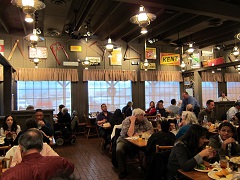
cracker-barrel-albuquerque-inside  Download    I had breakfast with my Dad this morning.  Through mouthfuls of biscuits & gravy from the “Old Timer’s” breakfast, he said, “Ya know what song I like?  Bet you never heard of it”.  Always up for a challenge, I replied, “Try me”. (clever, huh?)  He came up with something called “For All We Know”.  I thought it was the one The Carpenters did, but he insisted they must have stole it.  After he hummed a few bars (sort of) I realized that it did ring a faint bell.  I wanted to point out just how old that song must be, but he was buying – so I dropped the subject.

Well, it stuck in my head and I thought it might make a good old song for a nostalgic set on stage.  I did a little research online but found practically nothing on that particular piece.  I might point out there was plenty of information on The Carpenters song.  Then I found some sheet music and a recording of somebody named Barbara Law singing “For all we know, we may never meet again”.  That was it!  I jumped on my handy sequence maker (Yamaha keyboard) and cranked out a version I believe a singer could use. Thanks, Dad.


Save the Last Dance

thLLCOOJVU  Download with Lead    Several years ago, I found out who Michael Buble was.  Karen and I were doing a small wedding on the beach in Gulf Shores and the bride had a special request for the first dance (I hate playing weddings).  The song was “Save the Last Dance for Me”.  I thought, “Great!  The old Drifters tune – I know that.”  Turned out I was wrong.  We trotted out a Drifters version and she was horrified.  “That’s the right song,” she said, “but it isn’t”.  Excuse me?  She wanted it the way some cat named Michael Buble did it. Who?  We had to scramble around but eventually came up with this arrangement, and it’s how we still do it.  Much more interesting than the original.  I really have to keep up…. but I’m stuck in the sixties.