MaMa Told Me Not to Come

thOB61GA5Y  Right-Click to Download    “Open up the window – let some air into this room… I think I’m almost chokin’ – from the smell of stale perfume…And that cigarette you’re smokin’ – ’bout to scare me half to death… Open up the window – let me catch my breath”.

This is just one of the strange verses from a strange song recorded by the equally strange rock group Three Dog Night (remember, those guys also sang a song about a talking bullfrog who drank some mighty fine wine).  “MaMa Told Me Not to Come” is about an apparently sheltered young man attending his first “wild party” – his mother had warned him not to go and you should always listen to your mother.  It was written by Randy Newman for Eric Burden and The Animals in 1966.  The “Animals” version is just pathetic (google the video).  Luckily,  Three Dog Night came along in 1970 and put out a cover that was both rollicking and comic.  Worth re-doing today.

The problem with producing backups for this tune is the lead line.  The only real singing is in the chorus – the verses are all pretty much spoken words.  That’s hard to duplicate on a keyboard but you’ll get the idea (backups on the Pop/Rock list).  Learn this one and bring it back as a “golden oldie” – your mama will love you for it.
Bohemian Rhapsody

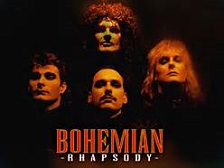
th0UC91US8  Download    File this one under “bizarre”… but fascinating.  “Bohemian Rhapsody” has no chorus, but is a “suite” of music consisting of 5 separate sections: the intro, the ballad, the opera, hard rock, and a reflective coda – all in the space of six minutes.  Written by Freddie Mercury with the band Queen, it’s a song you either love or vehemently hate.  Personally, I could go either way… but a trio of singers in Texas requested backups to it and this is the best I can do.

The intro is gorgeous – 4 part harmony like nobody’s business.  The ballad section has nice piano and tells a story of our hero killing a man and informing his mother “it doesn’t really matter” (oh…okay). The operatic passage (the Mamma Mia part) is quite thrilling and again with the wonderful harmony.  I always think of  the movie “Wayne’s World” when I hear the hard rock suddenly come out of nowhere.  Then it’s a sweet, soul-searching ending that belies the inherent violence of the song.  It’s a journey through one man’s psyche that showcases innocence, loneliness, and utter acceptance of the inevitable – death.  Pardon me if I wax philosophical but, damn… this song is dynamic!

It’s also extremely difficult to play.  The piano part was no problem, but when you try to add intricate vocal harmonies (at least what sorta-kinda sounds like vocals) and distorted guitars and kettledrums, well…. it gets challenging.  Hope Texas likes this one – I know we’ll never attempt to perform it. 

Take It Easy

thYGUI2XO0  Download    It is not my intention to turn this little blog into an obit column, but we’ve lost several giants in the music industry in a relatively short period of time.  In recent days, Natalie Cole and David Bowie have been taken from us.  Now, Glenn Frey, co-founder of The Eagles, has passed away.  If you’re under the age of 70, you grew up listening to the many hits of this band:  Best of My Love, Lyin’ Eyes, Heartache Tonight, Already Gone, Hotel California, Tequila Sunrise – just to name of few.  Glenn Frey had a hand in writing and performing all of those songs – he’ll be sorely missed.

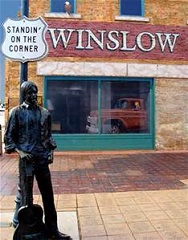
“Take It Easy” was recorded by The Eagles in 1972 with Glenn Frey singing lead vocals.  It was their first single and was the opening track on their debut album.  Jackson Browne (another super talent) actually began writing the song but never completed it.  Our Mr. Frey finished it for him by adding more lyrics and got permission to record it with his new band.   The most memorable verse is “Standin’ on a corner in Winslow, Arizona – such a fine sight to see – It’s a girl, my lord, in a flatbed Ford – slowin’ down to take a look at me”.

Because that second verse got so famous, the city of Winslow, Arizona erected a bronze statue (life-size) and mural commemorating the song.  The statue stands near a lamp post, the male figure holding an acoustic guitar.  Above his head there is a sign with the words “Standin’ on the Corner”.  The mural behind the statue is of a storefront with a window that reflects a red flatbed Ford pickup driven by a blonde-haired woman.  If you look closely at the picture above, you can see an eagle sitting on the upper left window.  Very cool.

As a singer, you should have some “Eagles” in your repertoire and this song is a good place to start (download my backup track on the Pop/Rock list).  Easy to sing, a good solid rock beat, and now you have a story to tell as you introduce this great tune.

Watch Glenn and the boys do this song on the link below:

http://www.bing.com/videos/search?q=take+it+easy+video&view=detail&mid=FDA4AB9CE2107322B79AFDA4AB9CE2107322B79A&FORM=VIRE9

Conga

thT05E1IJ9  Download    Your dance floor is packed and the final chord of “Old Time Rock’n’Roll” still hangs in the air. The crowd is cheering and clapping – wanting more. It’s that pivotal moment in the third set that every band waits for – when you’ve got the crowd in the palm of your hand. It’s time for…. the Conga line!

“Conga” is the signature song of The Miami Sound Machine with Gloria Estefan taking the lead.  It’s a great combination of fast, clever lyrics and a very busy Latin rhythm section – lots of congas, of course.  Our arrangement gives you plenty of time to talk to the crowd (“Everybody join the conga line!”) with elongated drum solos at the beginning.  You’ll get the first three brass section chords to establish the key, the singer does one chorus line to introduce the song (I’m using flute as the lead vocal), a piano interlude, then use the eight-bar drum solo to get the crowd up and forming a line.  From there, your singer can easily follow the movement of the song and come in at the right time with verses and chorus.  Easy arrangement and guaranteed to create beautiful chaos on the dance floor.

Nobody can resist a conga line as it wildly slides by your table – you just have to jump in.  This song is happy and fun and the beat is infectious.  If you’re new to the business and haven’t tried a conga in your lineup, this one’s for you.  I always want to join in myself, but that’s kinda tricky from behind the piano.

Brown-Eyed Girl

th8AFU7P1L  Download    At the tender age of 19, I played an 8-month stint at a lounge in downtown Mobile called “Admiral’s Corner”. I know, I was too young…  but those were different times.  I left there to do an elongated gig with the Air Force, spending a great deal of time at the piano providing dinner music in the Officer’s Club.  It wasn’t until years later that I found out that the long-haired dude who replaced me at that Mobile club was none other than Jimmy Buffett.  Jimmy hadn’t even written “Margaritaville” yet – that’s how long ago it was.

Van Morrison originally recorded “Brown-Eyed Girl” in 1967 (I can’t believe it’s that old).  He’s never received a dime of royalties for this tune (no lawyer when he signed the contract), and he intended the song to be titled “Brown-Skinned Girl” (something about a Jamaican girlfriend).  His original is a combination of jazz and soul and a bit harsh for my taste.  Whenever I performed it, I tried to smooth it out a little bit.  But then the master of “smooth”  (Jimmy)  covered the song on his album Boats, Beaches, Bars, and Ballads (now there’s a combination of beautiful things) and the song changed forever.

Jimmy’s take on “Brown-Eyed Girl” is how we do it today.  Every now and then we’ll trot out the Van Morrison style, but rarely.  We took a three year job at a local beach bar with an audience full of “parrot heads”, so nearly everything had to be done “Jimmy’s way”.  We just got used to it.  Down here, the man is king… as well he should be.

If you’re performing this classic (as I’m sure you are), download this sequence off the Pop/Rock list and try it Jimmy’s way… he won’t mind.

It’s Never Too Late

thVWPZLRZF  thA6JIDY7C    Carole King – it just doesn’t get any better than this.  Songwriter, performer, arranger, Grammy winner – what more could you want?  “It’s Too Late” is a song from her 1971 album Tapestry.  The lyrics describe a love relationship ending without assigning blame.  That, in itself, is quite remarkable.  We’ve all had affairs that ended without any reason – just didn’t work out.  But not many songs are written with that idea in mind.  Ya gotta blame somebody for the breakup – even if it’s yourself (the ol’ “it’s not you, it’s me” syndrome).

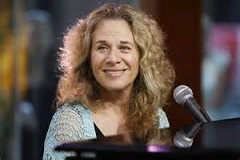
Now I’m gonna bring in a name you probably don’t know – Ms. Toni Stern.  Today she’s a successful poet and writer, but back in the 70’s, she wrote the lyrics to many of Carole King’s songs.  “It’s Too Late” was written about the breakup between Toni and James Taylor.  Carole King was playing piano in Taylor’s band at the time, but they weren’t an item… yet.  Toni wrote the lyrics in a single day and Carole put them to music.  That’s Carole on the left and Toni on the right in the above photos.  They look remarkably alike, don’t you think?

The song was written in the key of D minor.  The sadness of the song is emphasized by the minor key, according to Wikipedia.  Personally, I always enjoy playing in minors – brings drama to the music – and we all need a little drama in our lives (some more than others).  But the lyrics are eternally sad and bittersweet:  “Now you look so unhappy and I feel like a fool”.  Powerful stuff, there.

I was talking to a young singer the other day who had never heard of Carole King,  let alone this song.  Even though the song is from 1971, when she heard it, she loved it!  This backup sequence will help her reintroduce this song to the “millennials”.  I’ll guarantee ya, nobody will be singing “Nuthin but a ‘G’ Thang” 45 years from now.  Sickening.

The “Unforgettable” Natalie Cole

thD36H2YGV  Download Instrumental    I was in a music store in Ft. Lauderdale in 1992 trying out different keyboards, when an older gent came up to me and asked if I’d come play for his group. But to get the job, I’d have to play his favorite song “Unforgettable”. His “group” turned out to be 10,000 people living in a place called Century Village – my first introduction to the crazy “retired people” communities of South Florida.

I quickly learned the song and it became a permanent resident in my repertoire.  It was written by one Irving Golden and first recorded by Nat King Cole in 1951.  Golden’s original title for the song was Uncomparable, but the music publishing company decided it should be Unforgettable – works either way.  In 1991, Elvis Presley’s music director, Joe Guercio, came up with the idea to edit and remix  Cole’s original version to create a duet with his daughter, Natalie.  It won three Grammys in 1992.

Natalie was mildly successful in the mid-1970’s with such hits as “This Will Be” and “Our Love”.  Her career faltered through years of drug abuse, but she re-emerged in ’87 with a cover of Springsteen’s “Pink Cadillac”.  Through the 90’s she re-recorded standards by her father, resulting in her biggest success – “Unforgettable, with Love”.  You can download our backing tracks for this great Nat King Cole/Natalie Cole tune off the Pop/Rock list.

Natalie Cole died this past December 31st of congestive heart failure, brought on by her years of drug addiction.  Why, oh why, must they always go down that road?

Rainy Days and Mondays

th0Y7V429Y  Right-Click to Save    Well, it’s Monday… and its raining… hence, this song.  This 1971 tune by the Carpenters was the fourth #1 hit for the duo.  I was never a big fan of theirs, but if I had to pick a favorite Carpenters song , this would be it.

But this isn’t about Karen and Richard… it’s about their backup band. Studio (or session) musicians are never given their dues, unless they strike out on their own.  Producers would often use these anonymous musicians if they felt the competency of the real band was not up to par.  One group of session players became known as “The Wrecking Crew”.  They recorded behind nearly every artist that came out of California in the 60’s.  They got their nickname from the fact that older studio players from the 50’s thought this new generation was going to “wreck” the industry.  Several members of “The Wrecking Crew” went on to make a name for themselves, such as Dr. John (piano) and their upright bass player, Glen Campbell – yes, Mr. Rhinestone Cowboy himself.

I’ve known several studio players in my time and they’ve all been less than pleasant individuals – right up there with stand-up comedians.  They tend to look down on us here in the trenches trying to make a living.  But who can blame them?  We’re all out here trying to imitate what they did in the studio.  They especially don’t like people like me with arranger workstations who can mimic any instrument – one track at a time.  Doncha’ just love technology?

Superstar

th4YXSKWAR  Right-Click to Save    I would never, ever perform this song.  And I wouldn’t play behind a singer who wanted to do this song.  So there.  It’s the lyrics – actually only one line that ruined it for me, and that is “Baby, baby, baby, baby, oh, baby”.  I mean, come on – somebody couldn’t come up with more words than that for a crucial line in the chorus?  I made fun of it for years.

Of course, the Carpenters have the best-known version.   It was first recorded by Delaney and Bonnie, who did it in a very “bluesy”style – never a hit for them.  Then Bette Midler gave it a shot… no good (must have been that “baby” line).  Richard Carpenter heard Bette perform it on the “Tonight Show with Johnny Carson” and decided he wanted to cover it.  Karen Carpenter didn’t like the tune (had to be that line) but, after hearing Richard’s arrangement, she came around.

I didn’t pay much attention to orchestration before I started writing backing tracks for singers.  Now I don’t listen to lyrics anymore.  “Superstar” has great instrumentation – violins, piano, french horns, harp, oboe, and an entire brass section.  Quite a challenge to work all that in and still have a workable piece for a single performer or small combo.  Now I’m gonna rewrite that stupid line myself…… baby.

My Girl

thT7LFN57M  Right-Click to Download    Oh, boy… The Temptations! Harmony doesn’t get any better than this.  This one was their very first number-one hit, which was an emotional blow to Eddie Kendricks, their lead singer.  David Ruffin was recruited from background vocal status to sing the lead and pretty much took the job away from Kendricks for the rest of their career.  Ruffin’s voice was more mellow with a kind of gruff edge that worked extremely well with the Temptation’s style.  Sorry, Eddie…

The six ascending guitar notes at the top are most notable because they are a perfect example of a C major pentatonic scale, played exactly from octave to octave.  I always thought the beginning bass riff prior to the guitar was the “signature” part of the song, but what do I know?  I think when you hear the bass you say, “Hey, that could be My Girl” – then, when the guitar arrives, you know you were right.

If you’re a single performer out there using backing tracks, you can pay a hefty price for a professional sequence for “My Girl”, or you can use mine for free.  I’m not quite good enough to get the violins just right (especially in the middle eight), but who’s gonna notice?  No one yet has come up to us and said, “You know those strings aren’t quite right in that middle part there”.  But they will now….