Jammin’

th89J9GKBT  Download Instrumental    There’s no happier music in the world than Reggae.  What?  You don’t like reggae?  Of course you do – you just don’t know it yet.  And if you’re a singer/performer, you should LOVE Reggae.  There’s no easier style to sing because you can’t screw it up.  If you forget a line… who would know?  You can invent your own words on the fly and the crowd will be amazed that you’re so brilliant.  That’s just how forgiving this genre of music is.  It’s fun and carefree and perfect for a beach bar gig – and that’s where we all want to play, isn’t it?

Actually, Reggae really isn’t all that much fun if you really listen to the lyrics.  Reggae usually relates news, social gossip, and political comment.  It makes me wonder if romance and love just aren’t a part of everyday life in Jamaica.  The music sounds inviting and lighthearted, but that’s usually not the case.  I’ve always thought Reggae was primarily a defense mechanism against the poor economy and drudgery of life in that country – but that’s just me.

But this song is uniquely different.  “Jammin” is Jamaican slang for coming together and celebrating.  Now that I can appreciate.  Bob Marley and the Wailers released it in 1977 and it’s been redone a million times since then and played in every beach bar I know.  This is a really good arrangement, I think – so download it from the Pop/Rock list and head for the nearest ocean.  And, singers…. don’t worry about getting the words just right.  Nobody cares!  They’re out there on the dance floor groovin’ to the happiest music in the world…. or so they think.
Call Me Al

thGM2Y2HRK  Download Instrumental    My friend Charlene, a woman of dubious reputation, is the proud owner of an adorable stone owl which sits prominently on her fireplace mantel.  She’s elected to name him Al…”you know, from the song”.  It’s the perfect name for this critter and inspired me to pull that Paul Simon tune out of the storage bin.

“You Can Call Me Al” resides in my archives because we’ve never tried to perform it.  It’s simply too difficult, at least for me.  Oh sure, the song is fun and irreverent and has a great happy beat, but the lyrics… oh, man, the lyrics.  The words are so intricately woven into the music it’s almost impossible to figure out how to get ’em all in.  And they don’t make much sense, especially the third verse.  It’s vaguely about a man in the midst of a mid-life crisis who somehow ends up in a foreign country with some roly-poly little bat-faced girl in an alley somewhere.  I’m sure the meaning is clear as a bell to Paul Simon but he’s never bothered to explain them to us.  If I were you, I’d make up my own words.

I used a synthesized flute for the crazy melody line just so it would punch through.  There’s a penny whistle solo that I didn’t get quite right but it’ll work onstage if your audience is very forgiving.  The rest of the instrumentation was easy:  drums, bass, guitar and a little brass make up the whole arrangement.  It’s just those pesky lyrics that will give you a problem.  If you’ve got the vocal chops for this one, the sequence is on the Pop/Rock list.

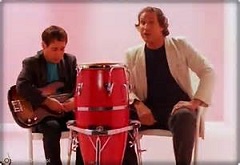
Yes, Charlene, there is an “Al” – thanks for your reminder.  Oh, and take a look below at the hilarious video with Chevy Chase lip-syncing the lyrics.  Notice how many times Paul twiddles his thumbs.  It’s worth viewing one more time if you haven’t seen it in awhile.

Copacabana

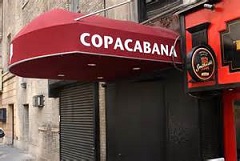
thFINTYBI1  Download Here    The Copacabana nightclub in New York opened in 1940 with mob boss Frank Costello as part owner.  It had Brazilian decor and Latin orchestras – but served Chinese food.  Uh… okay.  The club was also known for it’s chorus line, “The Copacabana Girls”, who had pink hair, mink panties and bras, and fruited turbans (my kind of place!)   It was a club where celebrities came to play and performers began their career.  Dean Martin and Jerry Lewis, Marvin Gaye, Sammy Davis, the Supremes,  Martha and the Vandellas, and Sam Cook were just a few of the artists that either debuted or frequently performed at this infamous night spot.

The place gained some unwanted notoriety on May 16th, 1957 from an incident involving the New York Yankees.  It seems Mickey Mantle, Whitey Ford, Hank Bauer, Yogi Berra and Billy Martin arrived to celebrate Martin’s birthday.  Sammy Davis Jr. just happened to be the headliner that night and a group of drunken bowlers began hurling racial slurs at him and it was getting out of hand.  This behavior incensed the Yankees and the huge brawl made headlines the next day.  Martin was traded to the Kansas City Athletics as a result of the incident.  ‘Course, later, he came back as the greatest manager the Yankees ever had… but that’s another story.

I happened to visit this iconic club in 1976 after it had been turned into disco.  It was okay but I wasn’t terribly impressed.  Barry Manilow, however, thought it was cool enough to write and record this song dubbing the Copacabana as “the hottest spot north of Havana”.  He released it in ’78 and it became a huge disco hit even though that era was slowly coming to an end.  I’ve always enjoyed performing this song mostly because of the infectious, exciting Latin beat.  Download it off the Pop/Rock list and bring it to your stage.  Your crowd will dance and sing along if you do it right.

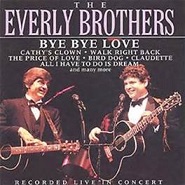
Bye Bye Love

thI0L3VZSS  Right-Click to Download    This request is from two guys in Decatur, Illinois who play banjo and guitar and work as a duo.  They needed backing tracks that only included guitar, bass, and drums – simple and uncluttered – I like that.  Of course, you can screw up that simplicity with too much banjo, boys – just sayin’.

They needed an Everly Brothers tune and “Bye, Bye Love” was the first one that came to mind.  ‘Course, I already had this one worked up so that made it easy for me – and these days I’m all about easy.  The song reached number one on the charts in the spring of 1957 and is ranked 210th on Rolling Stones Magazine’s The 500 Greatest Songs of All Time – so I guess that’s reason enough to put it on my list too.  Thanks for the heads-up, Decatur.

The original composition for this song didn’t include the guitar intro.  Don Everly insisted on tacking it on at the beginning to sort of make the song their own since they hadn’t written it.  The logic escapes me here because Chet Atkins played the lead through the whole song – not Don.  Oh, well…

I’m happy to see new entertainers interested in old songs – gives me hope for the future (unless Hillary gets elected -oops, I didn’t say that!)  And easy on the banjo there in Illinois…


Summer Wind

thRHU2Y9FU  Download Here    Oh, sure… I took music theory, counterpoint, orchestration and arranging in college, but it doesn’t prepare you for writing and producing a big band tune.  Nothing can get you ready for that daunting task.  It’s like an artist sitting down in front of a blank canvas and being expected to make something out of nothing.  If you’re a vocalist working alone in something other than a country music venue, you’re gonna want to do a big band once in a while- and you need good backup tracks.  I understand that – but, man, these things are a bitch to put together.

Okay, no more whining.  This a terrific song and worth the trouble.  But I have to point out that you singers get to step out there and belt it out with that natural vocal talent that comes so easily to you… and you get all the accolades and the star power and the money and….. I SAID NO MORE WHINING!  Sorry.  “Summer Wind” was first recorded by Wayne Newton, then Bobby Vinton, then Perry Como.  Finally, in 1966, Frank Sinatra came along and did it right.  Everything Sinatra touched turned to gold.  But then, he had a vocal gift that came naturally and he didn’t have to study or spends hours arranging or…. oh, never mind.  Just sing it!

It’s So Easy

thWSHAFU6L  Download    Naming your band after insects or animals doesn’t really sound like a good idea, but sometimes it works out very well.  A few that come to mind are:  The Beatles, Adam and the Ants, White Snake, the Animals, the Eagles, Wasp,  the Bee Gees, Papa Roach, the Turtles,  and the group who recorded this song – Buddy Holly and the Crickets.  Why “crickets”?  Well, for some reason, Buddy wanted an insect-inspired name and he almost went with “The Beetles”.  In fact, some years later, John Lennon and Paul McCartney decided on “The Beatles” as an homage to Buddy Holly.

“It’s So Easy” was never a hit for Mr. Holly and his insect friends – didn’t even make the charts when they released it on Brunswick Records in 1958.  If it hadn’t been for Linda Ronstadt trotting it out in 1977, the song would have faded into obscurity.  It was the first cut off her hugely successful album Simple Dreams.  She also had a #1 hit the year before with a cover of another Buddy Holly tune “That’ll be the Day”.  That album also escorted Elvis off the number one country spot after ‘The King’ had held it for 15 consecutive weeks following his death in August.

We’ve always enjoyed doing this song – played it every night in the late 90s and never got tired of it.  The vocals were especially fun.  We use Ronstadt’s arrangement mostly because it has a little more “meat” to it than Holly’s.  My Yamaha keyboard has great distorted guitars, and I left the backup vocal track in (vocal oohs) so you “newbies” can see how they work against the lead line.  This one’s a blast from the past, but it’s worth an encore.


Robert Johnson and the Devil

The Devil and Robert Johnson

Download

 On November 23, 1936, Robert Johnson (blues legend)  recorded “Sweet Home Chicago” in Room 414 of the Gunter Hotel in San Antonio, Texas.  It became his signature song, of sorts, even though other blues singers had put different lyrics to this exact same melody.  But that’s the common denominator of nearly every blues composition – you play the same three-chord progression over and over again, meanwhile inserting any words that come to mind as long as you repeat the same line at least twice in every verse.  The true beauty of the blues lies not in the lyrics.  It’s the soulful skill of the instrumental solos between the verses that defines the art of “the blues”.  I must admit, I do love to play piano behind a good blues guitarist.

Robert was born in Mississippi in 1911 and became interested in music at an early age.  His mastery of the harmonica was quite remarkable for a six-year-old and his talents on that instrument only increased as he got older.  What he didn’t have, no matter how hard he tried, was a talent for playing the guitar.  He was a traveling Blues player and guitar was imperative to his success, but he just couldn’t manage the finger dexterity or the ability to remember chords (even though there were only three of them).  His fortunes in the music business seemed bleak indeed.

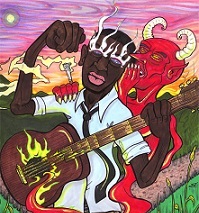
Then one night, at a crossroad outside of town, Johnson encountered the Devil – yes, ol’ Scratch himself.  The two of them apparently struck a deal that Robert thought was worth his soul.  Satan took Robert’s guitar, tuned it (is that all it needed?), then handed it back to Robert, whose eyes reportedly then glowed like hell’s fire.  After that, there was no explaining his new guitar-playing talent that has rarely, if ever, been matched.  Today, such notables as Eric Clapton and Keith Richards proclaim Robert Johnson to be the greatest blues player who ever lived.  And if you don’t believe this story, remember that the greatest trick the devil ever pulled was convincing the world he doesn’t exist.

Our hero died at the tender age of 27.  After being caught red-handed with a bartenders wife, she slipped him a bottle of whiskey which he eagerly guzzled down (that’s our boy).  Unfortunately, the whiskey was poisoned – by whom, we don’t know.  Could have been the irate husband, or the wife herself, or another woman angry at Robert’s philandering.  We don’t even know for sure where they buried the body.  Ah… a life fraught with mystery.

He only had a handful of recorded songs and “Sweet Home Chicago” is one of his best.  It’s on the Blues List if you want to perform some standard blues.  You can look up his lyrics, or make them up as you go.  Nobody cares… it’s the Blues, after all.

Hit the Road, Jack

thMWQ7MMZP  Download    Quick… who did this song?  If you said Ray Charles you get a gold star.  It was written by R&B artist Percy Mayfield in the late ’50’s but didn’t become famous until Ray did it in 1961.  The story in the song is about some poor schmuck who gets tossed out of his house by a woman who’s finally had enough of his shenanigans.  Men, take heed… this one could be for you.

“Hit the Road, Jack” is one of those pieces that lives on forever – popping up when you least expect it.  Aside from being a huge pop hit for Charles, it was used as the theme song for the sitcom Unhappily Ever After.  In the early 90s, Kentucky Fried Chicken used a rerecorded version in their commercials – retitled”Cross the Road, Jack”. Cute.  In an episode of Two and a Half Men,  Charlie delightedly plays it on piano as Alan is finally moving out of his house.  Ray Charles’ version is played over the PA at Chicago Bulls games when an opponent is fouled out of the game.

I wish I had composed this gem.  I wouldn’t be writing this silly little blog if I had.  Well, actually, I probably would.  But we do perform it as it has nice vocal interplay between a man and a woman, using Buster Poindexter’s arrangement.  Buster and his woman actually have a rather lengthy conversation in the middle 16 bars, which is hard to duplicate with a keyboard – but you’ll get the idea where to sing or talk.  This version is fun, lively, and gives me a chance to use my horn section.  Give it a go…

Poindexter video below:

http://www.bing.com/videos/search?q=hit+the+road+jack+buster+poindexter+video&view=detail&mid=AFCCA06684ECC7285EECAFCCA06684ECC7285EEC&FORM=VIRE7


Happy

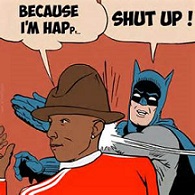
thULR76HXP  Download with Lead    I hate this song… I really, really do.  The lyrics are repetitive and banal, the music simplistic, and Pharrell Williams is just too damn happy to be real (the abrupt ending doesn’t help either).  I know, the rest of the planet loves this little ditty, but too much of a good thing gets tedious after awhile.

Pharrell wrote, produced, and sang “Happy” for the soundtrack of the movie Despicable Me 2, which was fun and stupid all at the same time (which kinda explains this song).  The instrumentation is sparse by modern standards:  bass, programmed drums (not even a real drummer, Pharrell?),  and a keyboard.  The vast array of backup singers pretty much makes the bass and keyboard players immaterial.  Bingo!  That’s why I don’t like this song!  I knew I’d figure it out if I whined about it long enough.

Sometimes you have to do things you don’t want to do, and this tune is one of them.  If you’re a singer without a band and using my backups, you’ll want to snatch this one off the Pop/Rock list.  You’ll get sick of it, but it’ll make your crowd…well, happy.

The video is sorta fun though:


My Funny Valentine

thVKIH4WY1  Download    This song ultimately became a jazz standard after it was first performed by child star Mitzi Green in the Broadway musical Babes in Arms.  In the original play, Mitzi’s character sings it to Valentine “Val” Lamar (played by Ray Heatherton), poking fun at some of his odd characteristics.  So, you see, this tune has absolutely nothing to do with Valentine’s Day, but musicians insist on playing it anyway on the big day.  We’re an insufferable bunch.

“My Funny Valentine” has been recorded by everyone from Sinatra to Ella Fitzgerald – all in the same boring, maudlin style.  They drag out that first “Myyyyyy” so long you’re sure that’s the only word in the song.  We arranged our own version as a slow foxtrot that your crowd can dance to without falling asleep on the floor.  If you’re going to trot this one out yet again on Valentine’s Day, give this arrangement a try.  It’s on the Jazz/Swing list.