Tell It Like It Is

  Download Instrumental   There’s a certain vocal styling I just hate.  I call it the “Aaron Neville Slide”.  Neville started this foolishness in 1966 with this song – “Tell It Like It Is”.  You know what I’m talking about.  The singer ends a phrase and then slips and slides all over the final note until you don’t even know what the note was.  Drives me crazy.  That style ended after a few years, but then Whitney Houston brought it back with a vengeance and it never went away.  Just listen to someone sing the National Anthem.  They can’t help themselves.  Drives me crazy (I already said that, I know).

They call them “vocal runs”.  I call them “irritating beyond belief”.  Just stop it!  It’s not necessary!  End the phrase with a nice strong note that speaks for itself (a little vibrato would be nice).  I love this song – but NOT the Aaron Neville original.  I stumbled across a version by Don Johnson (yes, the Miami Vice guy – who knew?) and he doesn’t do all the vocal theatrics that have become so ridiculously popular.  He sings it straight and pure – the way any song should be done.

I used Johnson’s version as a guide and came close – with no real cigar.  I liked his arrangement mostly because of the sexy saxophone licks (that was fun to do).  I did, however, leave plenty of room at the end for all you singers who just insist on doing the “Aaron Neville Slide”.  But, please… just don’t.

 

Feeling Good

  Download Instrumental   I never heard of this song. Forty years in the business and this one escaped me.  I finally heard “Feeling Good” last year on one of those irritating TV talent shows that only features vocalists.  I like it… I think.  The melody line is a bit elusive, but it’s an emotional song and every singer will tailor the melody to their own style.  As I’m inclined to do so often, I used Michael Buble’s vocal interpretation as a guideline.

This one was written in 1964 for a Broadway play best left forgotten.  A popular singer at the time, one Anthony Newley, wrote the tune but rarely performed it.  His signature song was “What Kind of Fool Am I?” – a song I always announced would be the “bride and groom” dance at any wedding I played.  The bride never smiled, but brides are nearly always a pain in the patoot anyway (you’d think it was an important day or something).  I didn’t care – the bride’s father was paying the band – and he always laughed.  There’s a moral there somewhere…

Anyway, a glorious singer named Nina Simone released this one in 1965 and absolutely nailed it.  Several more artists tried their versions and just destroyed the innate beauty of the song – most notably the band Muse in 2001.   Most young singers today identify with the Muse version, which is regrettable – and unforgivable.  Michael Buble came along in 2005 and did it right – using Nina Simone’s arrangement almost note for note.   If you’re going to take this masterpiece to your next gig, do it this way, please.  Don’t fix what ain’t broke, folks.

Breaking Up – Slowly

  Download Instrumental   It’s “ladies’ choice” time, folks.  And the perfect song for the ladies to pick their dance partner is this classic gem from Neil Sedaka, “Breaking Up is Hard to Do”.

When the uptempo version of this tune came out in 1962, it was described as “two minutes and sixteen seconds of pure pop magic” and was Sedaka’s first number one hit.  Personally, I would describe the original version as “bubblegum pop” – I never particularly cared for Neil Sedaka anyway (I know, it’s a sin to say that).

But THIS arrangement of the song…well, that’s a whole ‘nother story.  Lenny Welch originally came up with this slower adaptation in 1970 and had a fairly decent hit with it (went to #34 on the charts).  It took Sedaka another five years, for some reason, to come to his senses and turn the song into a gorgeous ballad (like Lenny did).  When Neil finally re-recorded it in ’75, “Breaking Up” charted top ten overnight.

The original version sounded like the guy was glad to be breaking up with his girl.  It was like “Yaaa! I’m dumpin’ the twit, finally”.  But this one expresses sorrow and remorse (and don’t we all love that).  He desperately wants her back, and the slight breaks and inflections in the melody let you know he’s on the brink of tears.  Having to say goodbye is breaking his heart.

Perform it this way, you singers out there.  Jazzy piano and lush violins beat “bubblegum” every time.

Volcano

  Download   We played beach bars for years, and this was certainly our most requested song, just ahead of “Margaritaville”.  When you’re on the beach, Jimmy Buffett just screams to be in your play list.  What a life that guy has lead…. I’m jealous.  Anyway, this is our version of “Volcano” that we’ve used since the 90’s.  But the song comes with a little bit of history…

In 1995, if you happened to live on the island of Montserrat in the British West Indies, you might have awakened one morning with a sense of foreboding.  There is the slight smell of sulfur in the air and a low rumble from the south end of the island, where the Soufriere Hills volcano lies dormant and quiet.  But not this morning.  Today it suddenly erupts and destroys most of this 10-mile-long piece of paradise in the Caribbean.  Two-thirds of the population were forced to flee and, to this day, the southern half is uninhabitable.

Sixteen years prior to this horrific event, Jimmy Buffett and band recorded the song “Volcano” on this very same island.  Lyrics like “Ground she’s movin’ under me” and “Sulfur smoke up in the sky” proved to be the dark future for Montserrat.  Perhaps we should add “prophet” to Jimmy’s many talents.

But this tune is light-hearted and fun (notwithstanding the history) and always gets a great reaction from your crowd.  I do hope Buffett doesn’t write a song about hurricanes since we’ll be in the season in a couple of months.  Oh, wait… he did! There’s “Surfin in a Hurricane” and “Tryin’ to Reason with Hurricane Season”.  Jimmy, lay off the natural disasters, okay?

Ruby

  Download   I’ve never liked anyone named Ruby.  Well, truthfully, I’ve never met anyone named Ruby.  But if I did, I wouldn’t like her… because of this song.

Oh, this Kenny Rogers classic starts out innocent enough: “You’ve painted up your lips and rolled and curled your tinted hair”.  But then it gets just a bit ominous with “Ruby, are you contemplating going out somewhere?”.  Hmmm…. husband doesn’t seem to be going along.  Then it’s  “Oh, Ruby, don’t take your love to town”.  She’s takin’ her “love” somewhere and he’s not invited.  Houston, we have a problem…

“Ruby, Don’t Take Your Love to Town” is quite sinister on several levels.  We find our hero is paralyzed and apparently sits helplessly in a wheelchair – a victim of that “crazy Asian war”, Vietnam.  She’s getting all painted up to go out and leave him there for the night, in spite of his entreaty that he “still needs some company”.  Not feelin’ real good about her now, are you?  But then he gives her an excuse: “It’s hard to love a man whose legs are bent and paralyzed – and the wants and needs of a woman your age, Ruby, I realize”.  Okay, hormones and all that.  Kinda-sorta understandable.  But then he says, “But it won’t be long, I’ve heard them say, until I’m not around”.  BAM!  Right back in the bitch category!  The door slams – she’s leaving anyway – as we knew she would.  Our hero mutters to himself, “If I could move I’d get my gun and put her in the ground”.  Okay, that’s disturbing, but who can blame him?

Still want to perform this song?  In the right venue, this piece would be a definite crowd-pleaser.  It’s the very last spoken line that will sell this one onstage for you – both chilling and heartbreaking at the same time: “Ruby… for God’s sake, turn around”.  Save all your emotion and drama for that one sentence.  Lower the mic, drop your head, and let the stage lights slowly fade.  Powerful…

Sweet Little Sixteen

thh8ri0iww  Download   For years, every time I heard Chuck Berry do this song, it reminded me of another song but I could never quite put my finger on it.  Then, I heard The Beach Boys do “Surfin’ USA” and there it was – the exact melody line stolen from “Sweet Little Sixteen”.  After a little research, I discovered that Berry sued that way over-rated beach band for plagiarism…  and won.  No money though, just composing credit.  Think I’d have gone for a little cash, myself.  Just sayin’…

There’s nothing even a little bit lascivious in this song, though some may insist the word “underage” should come to mind.  Actually, while on a package tour in 1958, Berry encountered a young teenage girl who was relentless about getting an autograph from every headliner in the show.  She didn’t even see the performances since she was so intent on getting those signatures.  Hence the lyrics in the song  “Sweet little sixteen – she just got to have – about half a million – framed autographs”.

This the only Chuck Berry tune that doesn’t really feature a guitar.  The piano shines throughout (Jerry Lee Lewis style) – which suited me fine.  Even without the typical Berry guitar solo, this one was his second biggest hit.  The biggest?  “My Ding-a-Ling”, of all things.  Go figure.  It was one of those songs that all the fuddy-duddies wanted banned from the airwaves.  Surprise!! Number one hit!   Don’cha just love irony?

Now, I think I’ll take my little ding-a-ling and mosey on home…

I Only Have Eyes For You

untitled  Download Instrumental   This jazz standard has quite the history. Written in 1934 for the musical Dames, it’s an absolutely wonderful piece of music with a chord progression that is delightful to play.  Lots of augmented fifths and diminished 7ths in a jazz score.  And the melody line is smooth like butter.  “I Only Have Eyes for You” is just one of the best songs ever.

But it didn’t start out that way.  Dick Powell and Ruby Keeler introduced the song in Dames,  but it was just horrible (sorry, but it was).  But the beauty of the song was there, and it was  25 years before somebody recognized that fact.  Finally, in 1959, The Flamingos recorded a version that was close to what the song should have been.  The addition of the background vocals “sha bop sha bop” was really not a good thing, and certainly unnecessary.  Just play it straight, please.  Without all the “bebop” additions, the song sells itself.  It’s beautiful – ya don’t have to screw with it!  And Art Garfunkel should have stayed away from it completely.

This is our version and it’s always worked for a crowd that was ready to dance close.  And “close dancing” is ALWAYS a good thing… especially on Valentine’s Day.

Twist ‘Til Ya Drop…

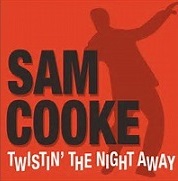
thb8erblew  Download MP3 Here   The great Sam Cooke had several huge hits in the early ’60s, among them “Another Saturday Night”, “Cupid”, “You Send Me”,  and this gem – “Twistin’ the Night Away”.  He was born Samuel Cook in 1931 and died (or rather was killed) just 33 years later.  The circumstances of his death don’t make for a pretty story and are disputed to this day.  You can “google” it if you’re curious.  He added the “e” to his last name in 1957 because he thought it was classier and would make him more appealing to white audiences.  Didn’t need the extra letter, Sam… your voice was all you needed.

Sam recorded “Twistin’ the Night Away” in 1962 using the best studio musicians in L.A. at the time – The Wrecking Crew.  Kind of an odd name for such a fine group of musicians, but it didn’t hurt their popularity.  They were the backup/studio band for just about everybody back then.  The likes of The Beach Boys,  Sonny & Cher, and Frank Sinatra used these session players in almost all of their recordings.  And they were the only musicians behind The Monkees since those boys couldn’t play an instrument to save their lives.

Nobody “twists” anymore (sad), but if invited to do so by a savvy bar band, they’ll do it forever.  That’s why I made this arrangement longer than usual.  It includes piano, sax, trumpet, and organ solos just to stretch it out a bit.  Give this one a shot at your next gig – they’ll twist ’til they drop.

Takin’ Care of Business

th34zlfec7  Download Instrumental   “Get off your seats and on your feets” is what we used as an introduction to one of the greatest rock dance tunes ever.  If this one doesn’t get ’em on your dance floor, you might as well pack up your amps and go home.

This is old time, head-bashing rock’n’roll – the same three chords played over and over again (in this case C, Bb, and F).  But the drum breaks and the guitar solos are fun and guaranteed to get the crowd going.  “Taking Care of Business” was written by Randy Bachman of Bachman-Turner Overdrive fame in 1967.  Bachman was inspired to write the song from a Beatles recording called “Paperback Writer”, a musical story about a man writing paperback novels for a living.  “Business” may initially seem like an ode to the working man, but was really more of a slam against people who actually do work for a living.  “I love to work at nothing all day” is a great line for musicians who, as everybody knows, don’t have to labor for their money.  Right.  Let me tell you something…. oh, never mind.

The piano track was played by a guy delivering pizza to the studio where BTO was struggling to get this song recorded.  He told them it needed piano and he just happened to be a piano player.  They laughed, tipped him, and sent him on his way.  Hours later, still trying to figure out what to add to those three endless chords, they tracked him down and he got his 15 minutes of fame (except nobody knows his name).  The piano saved the day… as it always does.

I’ve seen pictures of Elvis wearing a “TCB” necklace.  Makes me wonder if those letters have anything to do with this song.  I mean, if anybody “took care of business”, it was “The King”.

Introducing, the Man Himself…

thzhjt55gn  Download Instrumental   This is “Ol’ Blue Eyes” at his best. With lyrics like “Regrets, I’ve had a few – but then again, too few to mention”, how can you go wrong?

The lyrics to “My Way” were written by Paul Anka, but the melody came from a French pop song Anka heard while on vacation in the south of France.  He beat a path to Paris to negotiate the rights to the tune, which he acquired for the paltry sum of one dollar.  A dollar well invested, I’d say.

A few months later, he was having dinner with Frank Sinatra and “a couple of mob guys” when Sinatra expressed his disgust with the music business and that he was “getting the hell out”.  That’s when Anka got the inspiration for the first line of his “one dollar” melody.  He wanted to write it expressly for Sinatra to record before Frank retired, and the words “and now the end is near – so I face the final curtain” seemed like the perfect beginning.  The rest of the lyrics came quickly and easily and Frank loved it.  He considered “My Way” to be a final gift to his fans.

I recently watched a world leader mouth the words to this song at his Inauguration Ball, and I couldn’t help but remember the final line that Paul Anka wrote so many years ago – “the record shows – I took the blows – and did it – my way”.