Fun Fun Fun

  Download Instrumental     Does the guitar intro to this “Beach Boys” tune sound familiar?  Of course it does.  It’s the exact same intro (note for note) from the Chuck Berry song “Johnny B. Goode”.  Why they had to steal it is beyond me.  But it gets worse.  Chuck Berry first stole the intro from a 1946 tune called “Ain’t That Just Like a Woman” by Louis Jordan.  I guess all’s fair in love and song intros.

“Fun, Fun, Fun” is about a girl who borrows her daddy’s Thunderbird but doesn’t actually go to the library to study – imagine that.  Instead she terrorizes the town with her fast, reckless driving, making the boys adore her but the girls not so much.  But, hey, she’s having fun, at least until “her daddy takes the T-Bird away” – which he eventually did.  The lyrics to this one tell a little story, which was typical back in the 60’s.  Songwriters don’t do that much anymore (sad) and that’s all the more reason to bring The Beach Boys back from rock’n’roll oblivion, although they’re still wildly popular in some age groups.  A “twenty-something” might scratch their head and wonder where in the world did that song come from, but just tell ’em “California” and escort their butt out to the dance floor.  It’s time the younger generation learned what real music is all about.

Murry Wilson was the father of three of the band members (Brian, Carl and Dennis) and was also their manager.  He had very conservative values and thought this song was immoral and didn’t want it recorded (what would Murry do today, I wonder).  He didn’t get his way and was fired soon after “Fun, Fun, Fun” was released.  Take that, Murry!  Don’t you know a hit song when you hear one?  But how do you fire your own father?  That had to be interesting…

Girls Grow Up Faster Than Boys

  Download Instrumental    “Dear Dave”, the email began.  Don’t you love it when someone puts “dear” in front of your name?  Makes you feel all special.  Obviously, this person doesn’t know me.  It continues: “Would you please, please, please do an arrangement of a song called ‘Girls Grow Up Faster Than Boys’ for us?”  I love it when they beg.  Then she indicated that she didn’t care what it cost.  Even better.  Turns out, she’s a member of an all-girl group in Chicago performing songs from the early 60’s.  The song she wants was recorded by a trio of “chick” singers in 1963 called “The Cookies” – new one on me.

“The Cooklies” had one big hit – “Don’t Say Nothing Bad (About My Baby)” –  which I actually have heard of but the song is so repetitive it’ll drive you insane.  Two minor hits included “Chains” (later recorded by The Beatles) and this little gem –  “Girls Grow Up Faster Than Boys”.  They later became “The Raelettes”, backup singers for Ray Charles.  They also sang backup behind “The Locomotion” by Little Eva and Neil Sedaka’s hit tune “Breaking Up is Hard to Do”.  Well, it seems cookies are a good backup to everything.  Chocolate chip, anyone?

While I think everyone would agree that girls do, in fact, grow up faster than boys, this song about that phenomenon would not fly today.  Lyrics such as “Once you used to date my big sister, but now she’s too old for you – won’t you take a look at me now” gives one pause.  Follow that up with “I’m everything a girl should be now – thirty-six, twenty-one, thirty-five” and you’ve got yourself a class-action suit.  Besides, isn’t that “21” reference a bit tiny around the waist in proportion to the other two numbers?  Sexist, I know… so sue me.

The one thing I do like about this song (other than someone was willing to pay for it) is the slightly dissonant saxophone licks.  That was fun, and proves to me the whole piece is pretty much “tongue-in-cheek”, which makes me feel better about the whole thing…. but not much.  How this one will play in Chicago is anybody’s guess.

Land of a Thousand Dances

  Download Instrumental    The title of this song never appears in the lyrics – go figure. It’s just a list of dances that were popular at the time – that time being the early 60’s.  We seem to be stuck in the 60’s here at the old studio, don’t we?  Not a bad place to be.  That’s when all the really good music came out.  Everything else since then is a just a variation of what we did back then….. some of it good, most of it bad.  But that’s just me.

Fats Domino got composer credit for “Land of a Thousand Dances” even though he didn’t write a word of it.  A chap named Chris Kenner penned the tune, but offered Fats half credit and royalties if he recorded it.  I hate to say it, but Domino’s version sucked – big time.  Kenner then recorded it himself  with only minor success.

The original arrangement didn’t have the signature chant “Na-Na-Na-Na-Na-Na” in it.  It took a Mexican-American band called “Cannibal and the Headhunters” to make a real hit out of it in 1964.  They added the “Na-Nas” and upped the tempo considerably.  Bar bands at the time loved the energy and chaos it created at one in the morning when the crowd was either sleepy or drunk.  I played it once myself for 30 minutes just to watch people go crazy. Big fun…

Singers, take this one and substitute today’s dances (do they still name dances?) in place of “the Jerk” and “Mashed Potato” or “Funky Alligator”.  Hmmmm, now that I think about it, maybe it’s a good idea NOT to name the dances today.  I sometimes dance to this one in the shower… yes, I do.

Sweet Home Alabama

  Download Instrumental    There are some songs that become iconic for no reason whatsoever. They are usually three chords played over and over again (and again) with a monotonous melody line.  Tedious is what it is.  But the minute the first two notes are played, everybody knows what it is and hit the dance floor running.  “Sweet Home Alabama” is one of those tunes.

Lynyrd Skynyrd , a southern rock band formed in 1965 in Jacksonville, Florida, wrote this piece as a tribute to Alabama and to the studio musicians at Muscle Shoals Sound Studio.  Those musicians were nicknamed “The Swampers” by Leon Russell and are  mentioned in the lyrics –  “And Muscle Shoals has got The Swampers”.  This is the one thing I like about  this song.  I’m always in favor of giving backup musicians credit where credit is due.

There is also the line “I hope Neil Young will remember, a southern man don’t need him around anyhow”.  Neil Young had written a couple of songs that were extremely critical of Alabama and the South in general (Southern Man and Alabama).  There was supposedly a nasty feud between Young and the band Lynyrd Skynyrd, but that really wasn’t the case.  They were actually all good buddies but the alleged “feud” helped record sales on both sides.

The song isn’t a complete love affair with the state of Alabama, however.  George Wallace loved the line “In Birmingham they love the governor”, but he really didn’t listen closely enough, because the lyric that follows is “Boo! Boo! Boo!”.  Ronnie Van Zant , lead vocalist for the band, claimed, “We’re not into politics, we don’t have no education, and Wallace don’t know anything about rock and roll”.  Probably all true.

Granted, this piece has some interesting history, but that’s where the fascination ends.  Musically, it’s a yawn.  But, singers, you have to do this one – it’s the law – at least in Alabama.  I’ve made my arrangement short and sweet with no frills or unnecessary solos – so you can get it over with quickly and know you’ve done your duty.  I’m looking at my set list this weekend and, sure enough – there it is – nestled smugly in the middle of the third set – “Sweet Home Alabama”…… sigh.

Blue Bayou

  Download Instrumental    Blue Bayou – Linda Ronstadt style.  This song came to mind when I heard a sports announcer (baseball) make a remark after the pitcher threw a fast ball strike and the batter didn’t swing.  The announcer proclaimed, “Whoa!  That was a Linda Ronstadt!”.  Say what?  What does a female rock’n’roll star have to do with baseball?  I checked it out.  What our sportscaster meant was – that fast ball “blew by you”.  Think about it…

“Blue Bayou” was written and first recorded by the great Roy Orbison in 1961, but not released until ’63.  The song peaked at a fairly respectable #29 on the American charts, but was a huge hit overseas, especially in Italy.  I don’t know, maybe they have a lot of bayous in Italy.  But in 1977, Linda Ronstadt took it and went crazy.  Her version was a hair slower with a cleaner, more pronounced beat (I chose to up the tempo a little – not quite so morose that way).  She took it to #3 on the Billboard Hot 100 and #2 on the Country charts – not to mention #3 on “Easy Listening” (never have figured out precisely what that means).  The single went Gold (1 million sold) in 1978, then soon was certified Platinum (2 million sold).  Personally, I think the key to her success with “Bayou” is the fact that Don Henley of the Eagles sang backup on the recording.  I think he was paid a hundred bucks for his contribution.   Ronstadt, you owe him big time!

This one would be a terrific addition to your repertoire.  It’s easy to dance to and very recognizable.  Surprise your crowd with this classic next Saturday night.  Batter Up!


The Heart of Rock & Roll

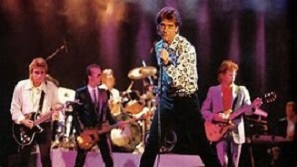
  Download Instrumental    Huey Lewis and The News – one terrific bar band made good!  This song, “The Heart of Rock & Roll”, is one of their most popular.  They have no hidden agendas and don’t delve into any political nonsense.  They’re all about straight up rock’n’roll music with no baggage attached.  As the song proclaims, “its still that same old back beat rhythm, that really drives ’em wild”.

“Rock and Roll” as a music genre came into its own in the late 40’s to the mid-1950’s.  It’s origins were gospel, rhythm and blues, jazz, jump blues and… country music.  That’s pretty much everything, isn’t it?  In the early days of rock’n’roll, the lead instrument was usually a sax or piano.  Sadly, those instruments faded into a backup role when the electric guitar came along.  While I love the thrill of a gut-wrenching guitar solo, it’s always nice when a sax makes an appearance, as it does in this song.  And then there’s the drums!  A rock beat is nothing more than a blues rhythm accented by a backbeat on 2 and 4.  And underneath it all, you have the bass holding it all together.  So there you have it – your basic rock band – two guitars, bass, and a drum kit.   But if a band is smart, they’ll throw in a keyboard or tenor sax just to keep things interesting.

Huey Lewis and The News are still touring – they’re on the road right now even as I type these words.  I did read, however, that they had to cancel a few dates because of “medical issues” with Mr. Lewis.  Hope he’s all right.  We need ya out there rattling our souls, Huey!

Singers without a band – put these backup tracks in your set list.  Makes a great opening number!

In the Midnight Hour

    Wilson Pickett trotted this one out in 1965.  “In the Midnight Hour” was his breakout hit to be followed by such classics as “Mustang Sally” and “634-5789” (my personal favorite).  He won a gold record for this recording and was inducted into the Rock’n’Roll Hall of Fame in 1991.

In this tune, the singer is waiting until midnight to meet his best girl.  Why so late, do you suppose?  Could be he was hiding something – maybe she was married – maybe he was.  A secret rendezvous would certainly be in order if that were the case.  Or perhaps she had skinny legs and he didn’t want to be seen with her.  That’s sexist, I know, but it was the ’60’s.  I always thought that meeting at midnight was something our hero believed would be incredibly romantic and exciting.  That’s my story and I’m sticking to it. But, not to worry – we’re assured that his love “comes tumblin’ down”.

Pickett co-wrote this song with guitarist Steve Cropper.  The first recording turned out to be something less than satisfactory.  None of the studio musicians liked it, but couldn’t figure out what was wrong.  They worked for days – changing guitar licks, switching out backup singers, adding organ – subtracting organ, more horns-less horns, but it still wasn’t right.  Finally, someone suggested changing the rhythm from a snare on every beat (Motown style) to an emphasis on the 2nd and 4th beat – so the teenagers could dance “The Jerk” to it (the current dance craze).  Voila!  Now everybody was happy.  They did, however, keep the snare on every beat during the horn solo, but we’ll forgive them for that.

“Midnight Hour” has been recorded every way imaginable.  Although I used Wilson Pickett’s arrangement as a guide for these backing tracks, I always liked the country version by a guy named Razzy Bailey. Give it a listen on the link below – you’ll enjoy it.

https://www.bing.com/videos/search?q=razzy+bailey+in+the+midnight+hour&qpvt=razzy+bailey+in+the+midnight+hour&view=detail&mid=8CD10C503F0983B762058CD10C503F0983B76205&&FORM=VRDGAR

California Dreamin’

    In my younger days, we all wanted to move to California. There were beautiful beaches, surfing, perfect weather, Malibu, surfing, sunshine… and did I mention surfing?  There was also a hot music scene.  Every musician I knew wanted to head west.  That’s where The Beach Boys were… and The Byrds… and John Sebastian.  There was also a little group called The Mamas & the Papas.  They recorded “California Dreamin’ ” in 1965 and started all this “hankering for California” nonsense.

It was written by John and Michele Phillips (before they formed The Mamas and the Papas) in 1963 when they were suffering through a particularly cold winter in New York.  Michele was from California and longing to go back…. hence this song.  Michele loved to visit churches in the city and dragged a reluctant John along with her.  A visit to St. Patrick’s Cathedral one day inspired  the second verse “Stopped into a church – I passed along the way”.  John hated the verse, as he had some past experiences in parochial school that were somewhat less than inspiring.  But he couldn’t think of anything that worked better, so he left it in.  The line “and I pretend to pray” might be an indication of his displeasure.  Always hated that line…

This piece was first recorded by Barry McGuire of “Eve of Destruction” fame.  It went nowhere, not even in the “Golden State”.  So John and Michele Philips, Mama Cass, and Denny Doherty gave it a shot and it went to number one on Billboard – though it took awhile.  The only real redeeming factor of this song is the flute solo in the middle.  I loved that – somebody actually playing an instrument rather than just standing there singing their lungs out…

As you may have guessed, I don’t like this song, or the group, for that matter.  But I’ve had several requests for backup tracks for this one so here it is, folks.  My arrangement is a bit “rockier” that the original, but I had to do SOMETHING!  We used to lust after those California beaches.  Now… not so much.


All Shook Up

  Download Instrumental    Imagine it’s 1957 and you’ve wandered into the local diner for a burger and a coke –  maybe some fries on the side. The jukebox stands in the corner,  beckoning you to put in a dime and spin your favorite record.  You sigh just a little  ’cause you’ve heard all the songs on that box a thousand times – seems nothing new is happening these days in the music biz.  You slide on over anyway and see something called “All Shook Up” by none other than Elvis Presley.  Hmmmm… something new.  In goes the coin and suddenly everything’s fun again.  You’re “all shook up”…  and that’s a good thing!

Songwriter Otis Blackwell put this one together for Elvis by accident.  Someone walked into Blackwell’s office one day shaking a bottle of Pepsi (Now, why would anyone want to do that?).  Blackwell was struggling to write a followup to “Don’t Be Cruel” at the time and this guy – we’ll call him “Shaky” – suggested he write a tune called “All Shook Up”.  Clever fellow.  The song was written in two days and became Elvis’ second biggest hit.  Ain’t life funny?

Elvis contributed the line “itchin’ like a man on a fuzzy tree” and therefore shared songwriting credit with Blackwell.  Doesn’t seem fair, but Colonel Tom Parker insisted on it.  What a guy.  Who made Tom Parker a Colonel anyway?  He was bounced from the Army for desertion.  And what’s a “fuzzy tree”?  I’m still working on why anyone would shake a Pepsi.  So many questions – so little time.

If I Fell

        Download Instrumental    What passes for a love song these days is just pathetic.  I’m not even going to comment on some of the trash that is out there today.   THIS, however, is a love song, and they just don’t write ’em like this anymore… aside from a few country artists.  In this particular tune, it’s all about the vocal harmonies.  I tried to duplicate those harmonies as best I could on a keyboard and it falls short, but you’ll get the idea.  If you’re a solo act, you’ll have a nice backup to your lead vocal.

“If I Fell” was written by John Lennon for The Beatles album A Hard Days Night in 1964, although Paul McCartney claims he also had a hand in its composition.  Doesn’t matter if it was one or both of them – it’s a masterpiece of brilliant chord progressions, beautiful vocals, and perfect instrumentation.  John famously claimed that he didn’t have a romantic bone in his body, but you’ve got to be a sentimental slob to write poetry like this – not that there’s anything wrong with that.

During the recording session, Lennon and McCartney sang together into one microphone – sort of Everly Brothers style.  John takes the lead on the first 8 bars that serve as a kind of introduction to the piece.  Then Paul takes over lead vocals and Lennon switches to harmony.  What made them do that I’ll never know but it works – spendidly.  There are no standard 8-bar verses and no real chorus – just an odd, unexpected chord (D ninth) at the end of 8 bars that leads you into a semi-chorus.  This is a challenging tune, but well worth the effort – it belongs in your “romantic” set, along with “Takin’ Care of Business”.

Whenever The Beatles performed “If I Fell” live, Paul would introduce it and John would mutter the word “over” at the end of the title.  Then they would giggle through the whole thing.  Well, that kinda sucks the romance out of the air, doncha’ think?  You can hear John screw it up on the video below.  No giggling allowed if you perform this one! And no smirking either!